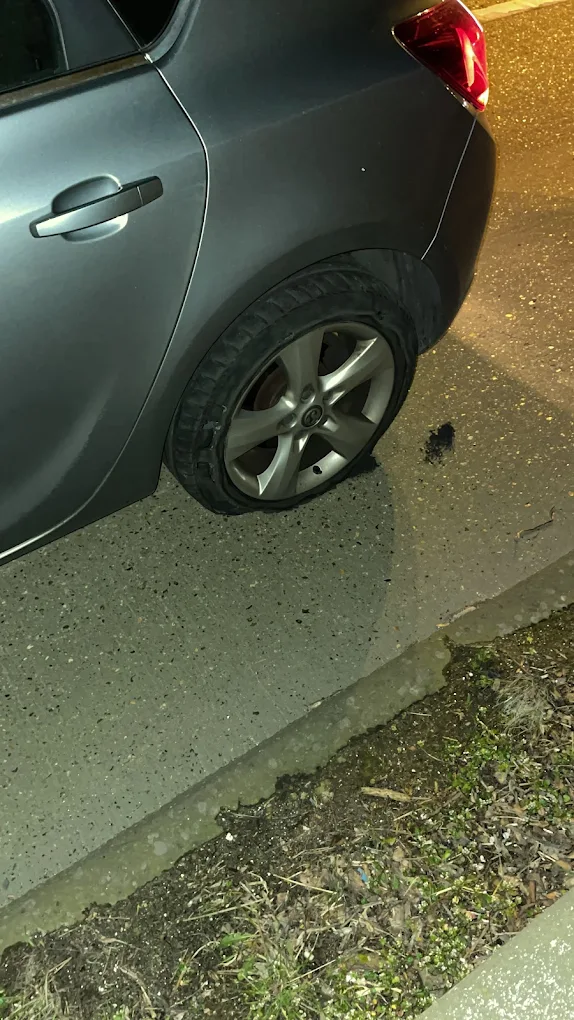
A flat tyre is one of the most common roadside emergencies — and one of the most stressful. Whether you’ve picked up a nail on the A312, had a blowout near the M25, or woken up to a flat outside your home in Hayes, knowing exactly what to do makes all the difference. This guide walks you through every step.
Step 1: Stay Calm and Get Safe
If you notice a flat tyre while driving, resist the urge to brake sharply. Instead:
- Ease off the accelerator gradually
- Keep a firm grip on the steering wheel — a flat tyre can pull the car to one side
- Signal and move to the left as safely as possible
- If on a motorway or dual carriageway, pull onto the hard shoulder and get out of the vehicle via the left-hand door, well away from traffic
- Switch on your hazard lights immediately
- If you have a warning triangle, place it at least 45 metres behind your vehicle (never on a motorway)
Step 2: Assess the Damage
Once you’re safe, take a look at the tyre. There are two main scenarios:
- Slow puncture — a small nail or screw has caused a slow leak. The tyre may still hold some air. This is often repairable.
- Blowout or rapid deflation — the tyre has failed suddenly or is completely flat. This usually requires a replacement.
Look for visible damage: a nail or screw embedded in the tread, a sidewall bulge or cut, or signs of kerb damage. Do not attempt to drive on a completely flat tyre — it will destroy the wheel rim and could cause an accident.
Step 3: Your Options
Option A: Use Your Spare Tyre (if you have one)
Many modern cars no longer come with a full spare — only a compact ‘space-saver’ that is only for temporary use (typically limited to 50mph and 50 miles). If you do have a spare and know how to change a tyre safely, this is an option. Be cautious: jacking up a car incorrectly can cause serious injury.
Option B: Use a Tyre Inflation Kit
Some cars include a tyre inflation/sealant kit (e.g., Fix-a-Flat). This can seal small punctures temporarily, but it’s only suitable for minor tread punctures — not sidewall damage or blowouts. It also contaminates the tyre, meaning a proper repair will be needed shortly after.
Option C: Call a Mobile Tyre Fitter
This is the easiest, safest option for most drivers. A mobile tyre fitter comes directly to where you are — whether you’re at the roadside, at home, or at work — and either repairs or replaces the tyre on the spot. No need to drive on a damaged tyre, and no towing fees.
Step 4: Call AK Mobile Tyre Fitting
AK Mobile Tyre Fitting is based in Hayes UB4 and covers all of West London 24 hours a day, 7 days a week. When you call us:
- Tell us your location and the tyre size (usually printed on the tyre sidewall, e.g., 205/55 R16)
- We’ll confirm we have your size in stock and give you an instant quote
- We aim to reach you within 30–60 minutes
- We repair if possible — replacement if not
- No call-out fee. You pay only for the repair or new tyre.
Can a punctured tyre be repaired?
A tyre can usually be repaired if the puncture is in the central three-quarters of the tread and the hole is no larger than 6mm. Sidewall damage, damage within 25mm of the outer edge, or anything larger than 6mm generally requires replacement. We assess every tyre and advise honestly — we won’t replace a tyre that can be safely repaired.
Areas We Cover for Emergency Tyre Callouts
We respond to flat tyre emergencies across Hayes, Uxbridge, Southall, Ealing, Hounslow, Slough, Wembley, Greenford and beyond. If you’re unsure if we cover your area, just call — we’ll let you know immediately.
Need a mobile tyre fitter in Hayes or West London?
Available 24/7 — we come to your home, workplace or roadside.